Pratham Arora
B.Tech. in Computer Science & Artificial Intelligence, Plaksha University (Graduated July 2026)
Research interests: Human-Computer Interaction, Human-AI Interaction, AI Agents for Interface Design, Evaluation of AI Systems
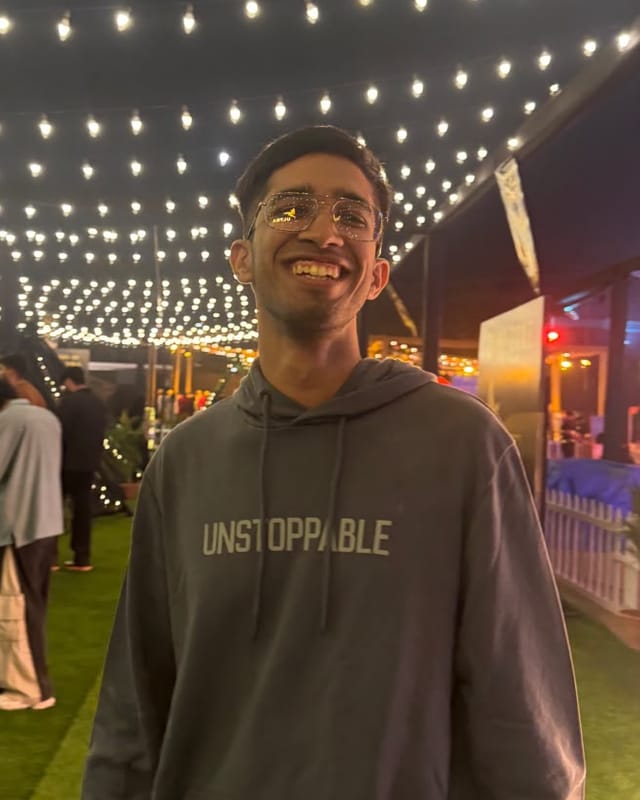
I keep building small, self-tested tools to remove friction from tasks I do myself - now AI agents build a lot of those tools and their interfaces, and the results often look finished while missing what the person actually needed. I want to study why: whether an agent misreads the design problem or just executes it poorly, and what design knowledge, given up front, actually helps.
Most of what I have built has been interfaces for the people around me: a basketball scoring site I kept editing for about six months of games, a browser-based auction slide generator for the sports society, and an elective clash checker for my cohort. Each one taught me more once people actually used it.
In research, I have looked at the same gap from two sides. At Plaksha's Human-Technology Interaction Lab, I ran a within-subjects study (N=18) on what an LLM agent in VR should do while the user waits for its reply. In vision-language research, I was the primary collector for an instrument-measured 459-image benchmark and wrote the error analysis of how frontier models get physical estimates wrong - some misidentify what they see, others identify it correctly and miscalibrate the number. Both times, what looked right was not the same as what was right for the person relying on it.
Where agent-made interfaces go wrong
Coding agents now generate user interfaces from a prompt. In my own projects, an agent given only a user flow produced a complete frontend that still put the wrong things in front of the user; it did better once I described the look of the site in detail. I want to understand that gap properly.
Framing failures vs. craft failures
When an agent-made interface fails, is it because the agent misunderstood the problem - the users, their tasks, what matters most - or because it executed a reasonable plan poorly? Design research shows expert designers spend more effort scoping the problem than novices do; do agents skip that step?
What design knowledge actually transfers
Teams hand agents guidelines, design systems, example screens and expert personas. Do these fix different kinds of failure? Examples help human designers but also make them copy flaws (design fixation) - does the same happen to agents?
What agents should show while they work
In VR, a loading spinner was honest about system status but made an LLM agent feel less human than thinking gestures did. Agentic tools now work silently for tens of seconds or minutes - what should they show the person waiting?
Papers & Preprints
Wait for It: A Component-Level Analysis of Latency Feedback Mechanisms for LLM Agents in VR
Under review, MIT Presence (2026)P. Arora, A. Lodha, Siddharth S.
Preprint ↗QUIVER: Benchmarking and Enhancing Physical Reasoning Abilities of Vision-Language Models
Manuscript under revision (2026)V. Lalwani, A. Shafiq, P. Arora, M. K. Gurumurthy, P. Pansari
PDF ↗Research
Primary collector for a 459-image instrument-measured benchmark and sole author of the model error analysis.
Preprocessing pipeline to improve zero-shot SAM segmentation on crop-weed imagery; vectorized batch processing for 10,000+ images.
Industry Experience
Automating the growth office's reporting workflows and contributing to finance data migration for the firm's in-house ERP.
AST-hash dedup cutting embedding costs by 85%; RAG over Cosmos DB vector indexing serving 17+ enterprise repositories.
Leadership
Coordinated grading-component scheduling across professors; built a tool for planning the semester around elective options.
Built and maintained a sports platform serving 500+ students; mentored 2 junior developers.
Led a team of 7–8 through 2 platform redesigns, growing the AI club site to 800+ monthly users.
Teaching
Designed lab assignments and supported weekly lab sessions for an introductory Python course.
Outside of work
I grew up on mysteries - Hardy Boys and Famous Five, then CID, which is still my favourite. At the moment I'm rewatching The Mentalist and watching Dark Matter.
Food: anything, honestly, as long as there's something sweet at some point - one dessert (or chocolate) a day is the rule.
In Valorant I main Fade, though my own paranoia keeps me from taking fights. I play noticeably better once my (much better) duo is dead and calling things out for me on comms. On the basketball court it's the same story: I'm the passer, not the shooter.
Now: Not building anything new right now - I'm going back through my older projects and fixing what I'd do differently today.
Academic Curriculum Vitae
Comprehensive academic CV covering research, publications, software systems, and coursework: